Christine Price on Perimenopause and Embracing Her Weird
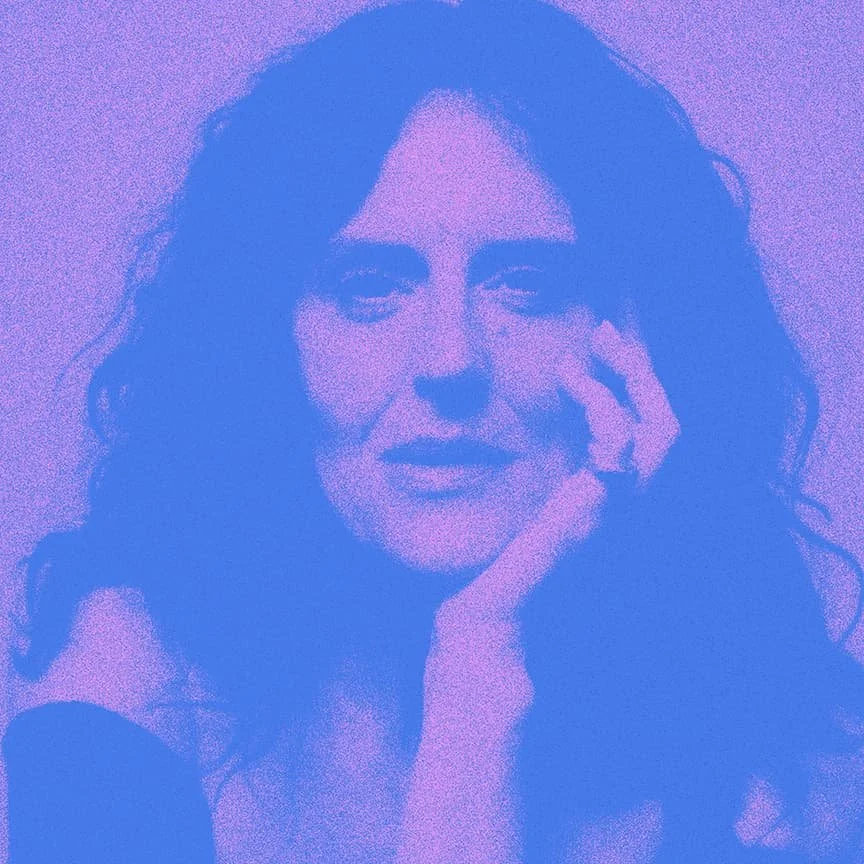
Photo by Yohan Kim, courtesy of Christine Price / duotone by Hot Flash Magazine
Self-portrait artist, actor, model and writer. Currently in perimenopause.
“…And even though it was milder than my mother’s generation, there was still very much this trajectory: then you find a partner, you get married, you get a house, you have children. So I think what I’m finding out about myself now is that maybe I don’t want a lot of those things. I was sold something that I don’t know I would buy again, in certain parts.”
Hot Flash Magazine: For our readers, Christine, are you peri or post?
Christine Price: I’m in peri.
HF: Could you respond to the idea that as a modern culture, we don’t have enough of that intergenerational learning between women in preparation for and during midlife?
CP: I can speak for my mother—there was no conversation. She just suffered through whatever she was going through. And now, even talking to her, she’ll say, oh, I don’t really remember that. Though she remembers the hot flashes. But I think because there was no conversation around the mental health impacts, which of course can’t be separated from it—of course she was having some, because it’s inevitable if she was having the physical symptoms. She would never, I don’t think, have articulated that that particular time was rife with any other symptoms. She was just moving through it by herself. And certainly her mother never talked to her about it. So this is it—the generational learning has to go beyond your immediate circle.
The focus currently—and I’m grateful we have this focus at all—is all about the physical symptoms. There’s so much more than that. The emotional, psychological, mental, spiritual list is probably longer than the physical one. And it’s a lot more difficult to pinpoint, because you don’t really know if it’s peri or just life. This is what I say often to my husband and to my close friends who have the context of my life and all the intricacies of having lived 52 years.
I’m very open about the fact that I have been dealing with some mental illness. I’ve been on medication for a while that helps me greatly, and then I went into perimenopause, and in the last year I’m also on progesterone. So now I’m wondering what’s what. And I ran into this thing where what was initially prescribed for HRT would have had an impact on my mood stabilizer. So I had to switch it up and reconfigure dosages. It’s like this great chemistry experiment, which is terrifying when you’re already someone who lives with anxiety and depression or mania. You’re playing with it, thinking, oh God, if I tweak this, I could fall into depression more, or I could go into mania more, and then I’m in this soup of emotion where I can’t figure out who that is and what’s temporary.
HF: Do you experience the need to clarify your emotions? Such as, is this feeling valid, or is this just the hormones? I’ll give you an example from my own experience. I feel rage sometimes, so I then ask myself, are these emotions surfacing because I’m at a specific date in my cycle — which is a theoretical date now because my periods are more erratic — or is it because my rage is totally legitimate because that dude is being a complete asshole? I have to analyze this in real time. I open my mental calendar. What day am I on? Okay, I think I’m on day 27, that tracks, I might be a little angrier than normal. But he did just do this thing. And then you’re kind of like, okay, I don’t want to be perceived as the crazy angry woman in midlife, so you’re analyzing all the ways you might be interpreted, and you make a decision in three seconds. But the aftermath of trying to untangle your response and your somatic experience afterward is exhausting.
CP: I think I spent a lot of time holding in a lot of anger and rage. I think a lot of women have, and did, and continue to. I’ll be straight up: I’m not a big fan of men right now.
My husband is a wonderful man—I want to say that very clearly. But the older my girls get, and the more experiences they have with men, the more that rage builds in me.
I think one of the most unsettling things, and maybe this ties into my mental health experience pre-perimenopause, before I was properly medicated—I lost my train of thought. I know what it was because before I was properly medicated, or had resources that for periods of time worked to ease some of those uncomfortable emotional experiences, I felt so lacking in resilience. And I feel like I’m back there again.
I don’t feel resilient. I know there’s a part of me that feels like I’m betraying the voices out there that are like, I am coming into my queendom, the golden age. I feel some of that on one hand. But truthfully, on other days, depending on where I am in my cycle—it’s really scary.
And then at the same time you’re also a little bit like, fuck it, I’m just going to be messy.
HF: The cleanup of that is hard and exhausting and never recognized, because that’s actually part of the labour. We’ve gotten good at it in the sense that in the moment we can do it in three seconds. But sometimes I need a glass of wine and a 45-minute bath to recover from it. And I get very tired.
CP: I was never a napper, and now once in a while, maybe once a week, I’ll have to just lie down. I might not fall asleep, but I need to lie down. It takes a lot for me to give myself permission to do that. My husband does, and has always been able to, just go and lie down and relax right away. That was never easy for me.
HF: I want to come back to the topic of resilience. In the instances when you’ve named it as lack of resilience, did you give yourself an additional shame layer? Or a pep talk? Like, we’re going to build some muscle around this?
HF: What does recovery look like for you? For me, to get back to baseline is recovery. It’s different from acts of creativity and play, and it’s different from maintenance. For me, exercise is maintenance.
CP: It was just despair. I went from full-on, I had no resilience, what the fuck I can’t—and then I’m in a place where it seems from the outside like I’m so busy and out there and amazing. But recently everything just feels like too much. I can’t. And I think this runs very parallel to my mental illness. Part of my mental illness, on the down spectrum, is depression, and how it manifests is a desire not to be—not to cure myself, that’s a different level. More like an escape hatch. Like, if I could just not be for a moment.
What’s also confusing for me is that I’m recalibrating my relationship to spiritual practice. I was so immersed in yoga—it was so much my identity for so long. I did a conscious kind of trial separation from it to reassess, and I’m still not sure where I am. What I mean is not the limbs of yoga practice, but what are my foundational, core beliefs?
All the practices of yoga worked for me for so long to bring me back to self or centre—until they didn’t.
And I don’t know if it’s a tolerance thing, where sometimes now I have a visceral reaction to spiritual language because I was in it for so long and saw so many sides.
CP: When I’m home by myself, I’m kind of trying to do all three. One thing I do is clean, because if I can unclutter and clear from the weekend—I’m the one who’s in our space the most, it’s my space of work and everything—clearing it is something I can’t wait to just get done. Then sometimes if I need to shake off some kind of containment I’m feeling, I might make art, because making art tethers me back to myself as a creative rather than someone who’s relying on an agent to bring me work. It reminds me of my own agency over creation and expression. But real recovery—recovery usually comes in the cleaning, and then taking my dog for a walk. Very simple, mindless tasks.
Movement is a really big part of my mental health. The thing is, as parents, there’s not a lot of time. I always carry a kind of baseline anxiety because I have this list in my phone, and I know if I knocked things off I could do it in one go, but then I’m also not getting to clean, not getting exercise, not getting to walk the dog. Everything’s running in my mind simultaneously.
But it’s really like, when you talk about recovery—I hadn’t thought about it, like, am I in recovery? On a day on my own, is it spent recovery? I’ve never really used that word.
The ultimate flex is to not care. What patriarchy would call letting go.
The ultimate flex is to not care. What patriarchy would call letting go.
HF: My rotator cuff has been a problem—tendon tearing, so I can’t do certain things overhead or load my shoulders much. So annoying, because it leads to less movement, which connects to everything. And I don’t want Hot Flash Magazine to be a glamorization of aging, because it’s not. If I had the option to get my 20-year-old body back, absolutely. That said, I love who I am now—I have way more compassion, way more resilience, I feel smarter than I’ve ever been. But I definitely wish I had a body that would just bounce back from anything.
I’m not good at resting. My identity has been so wrapped up around purpose and high functioning and productivity and being a strong, capable woman. And part of it is legitimately because I work for myself—I don’t have sick days, I don’t have vacation days.
CP: My husband and I are both self-employed, no health insurance. And I’ve chosen yet another career that’s completely unpredictable.. I’ve had some success with commercials, that’s a good chunk when it comes, and then it’s gone. So there’s a very real practical reason for the scarcity mindset.
HF: I relate to that so much. I’m like that too—if I don’t work, I don’t make money. There’s a real part of me too, seriously, and it’s not like, with enough affirmations you’re going to cure this. This is the reality of the system we’re in where we don’t have the same safety nets as someone who is employed.
I’m noticing my body is asking me to rest, and my creativity is asking me to rest, because when I’m well rested I am so creative, I am unstoppable. And I know if I could just give myself permission to trust that I will be okay, I will continue to do great things. But there’s a lot of guilt. I’m grateful that I hold a coven—and I’m not using that word metaphorically, it’s a legit witch’s coven, we gather online—and part of our work is also about encouraging each other to rest and help each other out when we’re struggling with that.
Why do you say you’re not a big fan of men right now—care to share a few specific reasons? I think many of our readers probably all feel the same, but I wonder if there are specific things.
CP: I’m looking back at the relationships I’ve had with men, and I’m starting to see the ways I was silenced, or manipulated. This came up for me during the Me Too movement, where we were all going, huh, right? I remember, for example, I was probably in my 20s, kind of dating this guy, and we were in his bedroom just hanging out, we’d gotten some sushi or something. He wanted to have sex and I didn’t. I was not into it, and I said kind of, yeah, I don’t feel like it. And he said, well, what do you expect when I have a beautiful girl in my room? Like, fucked up. And there have been lots of experiences like that.
A big part has also been having my girls. My girls have had very bad experiences with men early in their lives. My daughter was 11 when she was chased by a guy on a bike, chased her from the park all the way to the back alley of our house. She’s also been at the bus stop where an old man—she said he was like 50—said, you’re very sexy. She’s 11. She doesn’t know what to do. My other daughter has had experiences where a boy and his friend left her a message saying awful, horrific things. She was 14.
I have my own memories too. I remember going out for dinner with my dad and a business associate of his. The associate had his son, maybe in his 20s, and I think I was 13 or 14. We went back to our house and they were inside, and I was standing out by the pool, and this guy came toward me and sat down on a lounge chair. I can feel in my body the creepiness of it.
I think men are just given permission to do all kinds of things and hold themselves in positions of authority where women don’t, or aren’t encouraged to. I have visceral reactions to men being in positions of authority over me—a parking attendant, a boss, coaches in high school. They could be right about whatever they’re doing, but I get mad. But I never said it. So I think that’s why there’s this feeling of a powder keg that’s been waiting for years. I still don’t quite know where to put it, to be honest. I channel a lot of it through my art. But in daily life, not so much.
HF: Have you ever needed to be assertive for yourself? I find I have no problem doing it when I’m advocating for my sons at school. It’s easier to do it for them than for me. I’m learning to do it more for my health—if this doctor won’t believe me, I’ll look for a different doctor.
CP: The short answer is, unfortunately, no. And I feel like my response is still very much after the fact, internalized.
Or I lean sad—my rage and my sadness kind of join together, especially when it’s something unjust.
Two experiences that I had, and it’s funny because, like, I also it also makes me question in those cases, maybe I was wrong and was being called out. But there’s a different way that that interaction could have gone. One was when I was driving my girls to a movie, and this guy pulled up next to me while we’re stopped at an intersection, and he sort of, like, did a wave, then did this motion to put the window down.. So I opened my window, and he’s like, ‘You know, you’ve cut me off, twice as we are driving’. And I was like, ‘Oh, I didn’t realize that’. And then he’s said, ‘Yeah, so now, you know’, and he was saying it in a way, his tone wasn’t unfriendly. It was almost like, a bit friendly, like, I’m just letting you know that that could be dangerous. I could feel my body and my heart beating a little fast, then I say, ‘Oh, I’m really sorry’. Because, you know, that’s the pleaser. But then I, you know, roll up the window, and we go on.
And then I’m mad.
God, I’m using driving examples… it makes me sound like a bad driver. Another time I remember same thing, I was driving through an alley slowly stopped at the alley, and people walked by, and then this man pulled up next to me again, and was like, ‘You know that that’s where pedestrians go, you weren’t even looking’. And I was like, ‘Actually, I was’, but did I say that to him? No, I was like, okay, ‘Sorry’.
And I rage inside. Even in a dream, I pull back. I don’t speak up.
HF: I think we were talking about the emotional labour of trying to figure out where that feeling is coming from in you. You have this additional layer—medication and mental illness. You’re not starting at zero, you’re starting at a negative number. And all the more that must feel so burdensome, to just appear coherent and functioning while trying to do all the things that help you trust yourself. Because that’s the thing in perimenopause—what is that feeling? Where did that reaction come from? Is that perimenopause, or is that just a shitty day or a shitty person? Is it me or is it them? And for you, you’re already starting from a place where you’re not always accustomed to trusting your responses.
CP: It’s a huge endeavour to not let those things paralyze me, because that’s where I fall into—a state of paralysis. And interesting you’re talking about needing a glass of wine. I stopped drinking two and a half years ago. Good for, well—yeah, it’s hard and I miss it every day. We were watching a show last night and there’s a dinner scene and all these women are drinking wine and I’m like, that looks so good. Which also tells me that’s why I shouldn’t be drinking.
There’s a social component though too. I wouldn’t have called myself someone who was socially anxious or had any kind of social anxiety. I’ve always been someone who needs a lot of alone time, but I can go out and be big in the world. But the further I go into perimenopause, the less able I am to be in a social setting.
HF: Networking is just—I can’t. And I think it’s surprising to people because I’m so out in the world. I am increasingly needing to be home, and I don’t want anyone else home when I’m home.
CP: Oh my gosh. I feel so guilty saying this, and I also think it might be valuable for someone out there. I have three girls. They go to school. My husband is out most of the time—he does home renovations. When one of them is sick or won’t get out of bed or is like, I’m not going—I am so angry. No, no, no. That’s not how this works. We are together on the weekends. This is my space for five hours, whatever it is. And I get actually mad—I’ve actually cried and raged.
Not to anyone. I think they can sometimes pick up that I’m not happy. It depends on how much pressure I’m carrying that week. If it’s Sunday night and I’m like, tomorrow’s Monday, you’re going to have space—and then that doesn’t happen, it just throws me absolutely.
HF: [Laughs] Now we’re venturing into a whole other category. There’s one thing to be a woman in perimenopause, but also to have children at home during that time. My eldest is about to enter that phase—he’s almost 18, and I have another who’s 11. And I’m noticing I’m grieving because my 17 year old is going to be going away for university in September. All the emotions around, wow, that happened quickly, how did you grow up in the blink of an eye? All the moments where maybe I feel like I didn’t cherish him enough, or was hard on him, or didn’t show up to all the soccer games. And then there’s also the fear of, like, who am I when I’m not a mom? Even though I have my own career and have thrived in building my business. And where am I going to make new friends? Sometimes I catch myself with insomnia thinking about this at 3am. Am I going to be the senior who’s by myself at home, been granted my wish of solitude, and desperately lonely?
CP: And I think when we have a decline in estrogen, our nurturing instinct just isn’t there anymore. I’ve read something about it—the estrogen decrease actually decreases our capacity to kind of hold space or tolerate or endure the load we have been carrying. The nurturing, it’s a real thing.
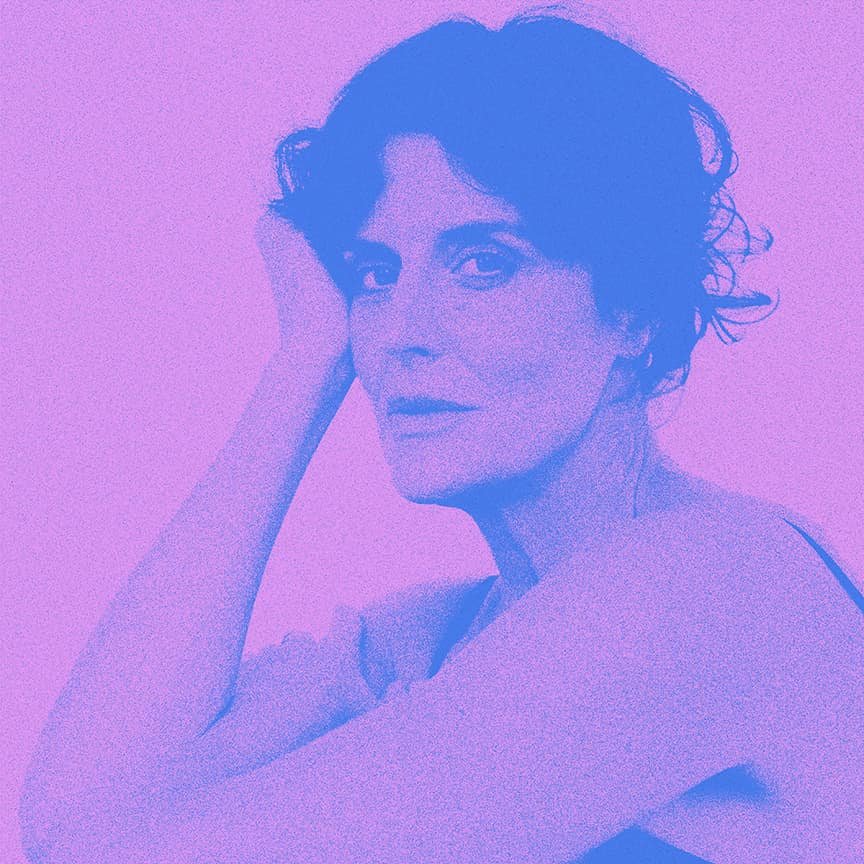
Photo courtesy of Christine Price / duotone by Hot Flash Magazine
HF: I noticed that with my friends—I’m asking them to show up to our friendship carrying their own load. I historically have been a very high-functioning human who was quite happy carrying other people’s load at my own compromise. It’s finally starting to come to consciousness, like, oh my god, you don’t like this anymore. You’re allowed to say you don’t like this anymore. But then not everybody responds well to the boundaries you have to put in place to not have that dynamic continue.
CP: It also depends on how far along they are on the peri train. There’s nothing more beautiful and energy-filled than two women talking about how angry they are. It’s pretty great.
HF: [Laughs] Going back—how are you navigating motherhood with peri, and the identity of all that too?
CP: It becomes how much do I have to hold space for my daughters, who are going through their own huge hormonal transitions. Also, you know, it’s crazy town in our house sometimes. My husband—when people say, oh, I have three daughters, how’s that being the only man in the house, he doesn’t entertain that kind of bullshit. They’re my daughters and my wife’s a woman. They’re all going to go through stuff. He’s not feeding into that. But at the same time it is a real thing—all four of us are moving through life in a very different way than he is.
I’m eager to have a relationship with my children built on really honest conversation. And going back to my feelings about men—I’m not wanting to tell them how they need to feel about things. But I also want honest conversations where they know that I know what it is to be a girl in the world. I want to equip them without over-influencing them.
If I choose one area—I think what I have come to realize as I move through this is mostly about sexual health. I’m watching my girls move into their experiences with their sexuality, my oldest in particular, and I want them to have really full relationships with themselves. I don’t think I had that until recently—even just the inquiry, the curiosity, the desire to really know who I am separate from any and all relationships, but specifically romantic or sexual ones. I’m in very age-appropriate conversations with them about their relationships to their bodies and embodiment. I think that’s a big one.
The more that I see, each of them with a different relationship to school and establishment—and I’m not about to homeschool. No. No, no, no, no. I would not be very good at it.
HF: Oh, totally. Homeschooling is not right for me or my boys. I mean, I’m also bothered by the level of performativity at a lot of schools—Pink Shirt Day, that kind of bullshit.
CP: And that’s probably a different experience for you being Asian.
HF: Big time. Being Asian and navigating these systems has been a disadvantage on all the obvious levels. But it’s also created a condition of pressure that has allowed me to I see through bullshit faster than the average. I can advocate better than the average because I’ve had to. I have stronger language around it, and I know the systems’ flaws more. It’s like a muscle—privilege means you don’t get to use it as much, less privilege means you use it more. I consider myself quite privileged, though. I can only imagine what it must be like for a racialized body who’s a single parent with fewer resources around them.
I’ve been described by a few people as a fierce mother, a formidable mother, which I don’t necessarily perceive myself as. But I think I’ve had to just step up for my boys because the system has so many flaws. My biggest thing is I’m tired. I don’t want to be strong all the time. I don’t want to be resilient all the time.
CP: We’re all so tired all the time.
I really have to assess more and more frequently whether I have the bandwidth to go to something that I’m invited to or to spend time with certain people. It’s weird, because it also is there’s a FOMO, right?
There are times where I just can’t, I just can’t, I can’t do it. I was at an event a few years ago, and I was telling myself that you’re fine [when I wasn’t] and then my body just pushed right back. Wise body, she’s saying, like, can you please pay attention to me? Is that my perimenopause? Is that my mental health, or is that my sobriety?
HF: I think all those things are revealing a very real thing, and we’ve been managing our anxiety and our obligations and our lack of excitement for doing something or whatever, through estrogen or whatever else. And in many ways, it’s a gift when it’s taken away from you, where you’re like, Oh, well, I never really wanted to do that. I kind of wanted to be in my cotton pajamas at home.
CP: I really relish one on one or small groups. Any more than that, I’m not interested anymore.
HF: I want intimacy, and I want realness. It seems to be easier to drop into that in one on ones.
CP: It’s been interesting for me to be sober, because booze is geared to women in the conversation around, [the phrase], we should get some wine.
HF: It’s a bonding tool.
CP: It’s kind of intertwined also with the kind of irreverent coolness, the youthfulness, the playfulness. [It suggests that] we’re together in this.
HF: What are you discovering or rediscovering about yourself as you are in relationship with yourself right now? What’s important?
CP: What I’m realizing—and I think this is probably very shared for a lot of women in this phase—is that I haven’t really spoken up in a lot of situations. I have also done things, lived according to what other people wanted. Watching my daughter talk about her next steps, you know—for us it was, you finish high school, go to university, get a degree.
And even though it was milder than my mother’s generation, there was still very much this trajectory: then you find a partner, you get married, you get a house, you have children. So I think what I’m finding out about myself now is that maybe I don’t want a lot of those things. I was sold something that I don’t know I would buy again, in certain parts.
HF: What made you buy into it? If you followed that track, what did you think it would give you?
CP: I think security. A home. Stability and love. Having it all in a little package—this is what you do. I’ve struggled with mental health my whole life. I remember being very young and having a lot of mental strife, having these same questions of, where is this coming from, that I’m now having in perimenopause. So I think, to some degree, the idea of a family unit represented normalcy, whereas I had always felt not normal. Even with my husband’s family, whom I love dearly—his parents were very much together and steady (to me)—versus my own (divorced and sometimes volatile in their co-parenting) , and his whole family was close-knit. They sat around the table and talked. They did their holidays together. And I fell in love with that too.
HF: I totally know what you mean. I feel like women—girls, actually, from birth onwards—and those AFAB (assigned female at birth) feel this way too—we were raised with this script: if you follow the script, you’re promised safety and security, and you wouldn’t be the “other” woman, or if you’re already an “other”, less so. That is the most terrifying thing to be when you’re shown it as an example of what you never want to be. Whether she’s called crazy or undesirable or whatever. And if you follow the script—maybe it’s not sold as a Disney package, but it’s some version of it regardless of where you live. The cosmetics and accessories look a little different, but it’s the same package. And for most of us, we stick to the script because it avoids the pain of being othered.
CP: And I think about that across all these stages—girlhood, into womanhood, into perimenopause and beyond. Are we the ones who need that work and that fixing or medicating? Or is it everything else around us that is totally fucked? I think, when I think about myself as a girl and as I grew up — I have so many experiences with people in my life, particularly men, where the narrative was: as soon as I showed myself to be who I actually am—creative, a little bit weird, artistic, multi-faceted, mercurial—I was immediately met with, that’s too much. Or do I sign up to be the arm candy? The safe woman?
HF: Tell our readers about your career.
CP: I’m an actor. I also model and make art.
HF: I have all these questions around modeling. You know, after the age of 50. When I go online, there’s more space and focus and centering of women over 50 in fashion than before. That said, we still have a long ways to go, as I see more women in their 60s, 70s, represented, but I don’t see women in their late forties and 50s so much. And in most cases of older models, they are thin, so there is still a following of a certain kind of script, right?
CP: There’s some age diversity, but there’s not a lot of body diversity.
I always loved fashion. When I had my third child, I realized it is not sustainable for me to be buying, like, high end, you know, $300 jeans or whatever. This is stupid. Not that I really was doing that, but I realized, for what I loved, I couldn’t do it. So I was started to get into consignment vintage. And really a world kind of opened up in terms of expression and that it didn’t have to be into ratty T shirts and like jeans and sneakers to be thrift and vintage, that it can look polished, cool or edgy or whatever.
So I started this account just being like it, literally, the first picture of when you go look at it is just me in an outfit, and it’s just talking about, think at the time, because we were, it was covid. I started this sort of tagline “What are you wearing in tonight?” Then it just evolved. And so I started by doing that, and then one day I woke up and had this other idea for a picture in my head that I wanted to create. And this is when the kids had gone back to school, and I woke up with this image, and the image was total departure from any of the photos that I’d done so far, because at that point, it was really just photos of me and clothes, and I would write about it.
One day I woke up with this idea that I was going to wear this black dress I had, and this hat and heels, and I was going to put my daughter’s two stuffed cats on leashes and have a martini glass and do an editorial shoot. I took my kids to school, came back, I think I shot it within half an hour, and I posted that, and something happened. It wasn’t because of feedback. Although the feedback was lovely, people were like, oh my god, it’s hilarious, but it freed something.
And from that photo onward, I began creating more of that nature. So I would dress up, and then I would sort of have, like a character that would come from that. And then I started integrating my writing into that. So I would write short fiction on the character.
There’s a lot of satire in there, and there’s a lot of ridiculous and I really, really embraced the weird of myself. So when it came to modeling as a job, I did it because my best friend had always sort of been like, why don’t you try it? I think you could. And I was like, I don’t really, how could I do that? Because I think I identified sort of as more ridiculous and I didn’t see myself represented either.
But [modeling] also wasn’t a goal. I started three or four years ago.
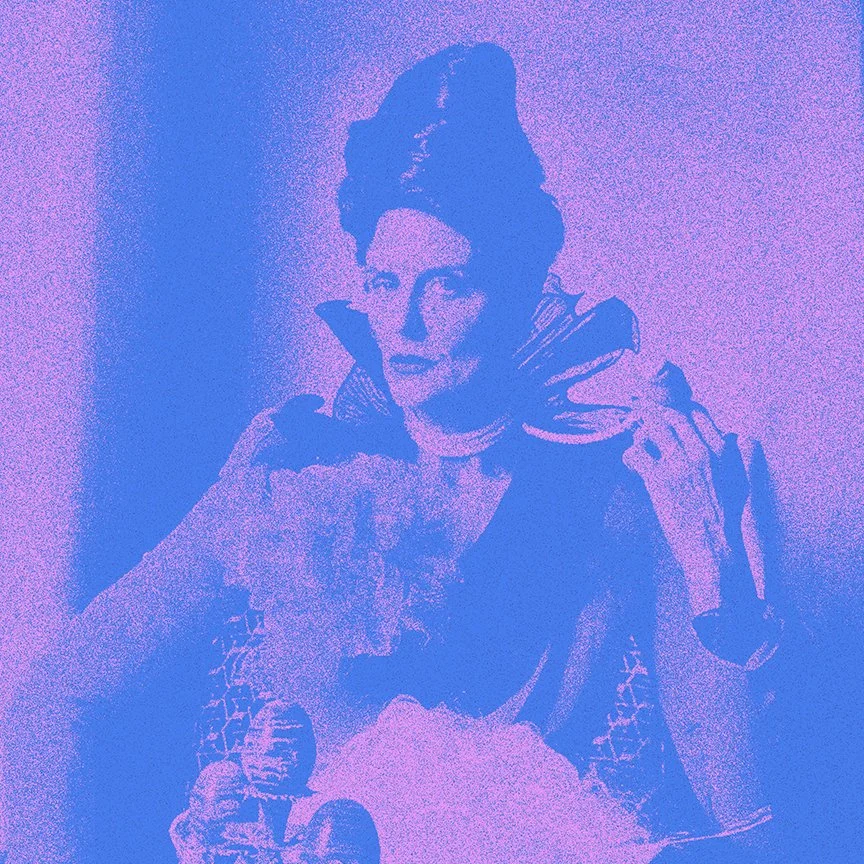
Photo courtesy of Christine Price / duotone by Hot Flash Magazine
HF: See, that’s the thing, we’re told by traditional fashion and modeling that your career is supposed to start when you’re 14 or whatever, and then you’re done by 30.
CP: Well, that was interesting too, because the further I’ve gotten into it, the more regular it is that people assume I’ve been doing it since I was young, or that I did it when I was young, and that I’ve come back to it. And that’s kind of interesting too, because actually I never did. My best friend was like, just try it out. After covid, and after a good amount of my own self expression, I thought, why not?
About the physical, I’d love to say that I’d love to be like, now that I’m in it, and I’ve been doing it for a while, I just embrace how I look. And because I embrace how I look, and I’m happy with my body, you know, bring on the wrinkles and La, la, la.
But that would be completely untrue to say that, because I think inevitably, it gets to you.
It’s hard. I have to remind myself like I’m not 20 anymore. I also love many things about how I look and I guess, and I feel very grateful, and I do my best to take care of myself. But I just think in terms of the the nature of that work in the industry itself. The inevitability of aging, if I’m really specific about the things that I see, I see my neck changing the most. That’s an area that’s been interesting. These smile lines—there’s the Marionette, these little pockets of fat on the lower outer edges where now I notice when a photo is taken at a particular angle. I think maybe the misconception is that, because you’re in this world, you’re celebrating yourself. I’ve had a photographer say at the end of the shoot, ‘I know a makeup artist who could take 10 years off your face’, something that “should be” desirable and aspirational for me.
I’ve also had a makeup artist tell me that I should Botox. This [points] forehead wrinkle could be done right away, because sometimes that forehead wrinkle does make me look older or angry.
And I have put on some weight since I began moving through perimenopause.
HF: God, totally. I keep needing to get new pants.
CP: And now I understand why people wear Capri pants. Like I never thought I would want to wear a nice [pair of] Bermuda [shorts], but our knees change, all of a sudden my knees look different. And my, my ass, you know, you can see it from the front now.
HF: [Laughs] Totally. And how we relate with the form of ourselves is changing.
You touched on another thing that’s been a lot on my mind. For me, it’s also intersected with the identity of mother, and then it kind of went away for a while, and it has come back during this year and last year in particular, as I’m navigating deeper into perimenopause, which is the concept of coolness. Can a woman in midlife be cool and fun? I mean, we know the answer here. But the thing is, society has a different definition for this for us. Cool and fun has been associated with youth culture for so long.
CP: I think as parents, we all have this like little joke among us. When people say to me, ‘Oh, you’re so cool.’ I always say, ‘Please tell my children.’
HF: [Laughs] I never once thought about if I was cool or not before having children, and after having them, this pressure to resist irrelevance became apparent.
"As soon as I showed myself to be
who I actually am — creative, a little bit
weird, artistic, multi-faceted, mercurial
— I was immediately met with,
that's too much."
—Christine Price
CP: As you get older, even with all the changes of body, you do get to know what you like more and what maybe suits you more, and what feels like you even when you have to figure it out a little bit. There is a sense of wanting to assert a sustained coolness, like I’m still cool. I think the word you used is interesting, relevant.
I think having a young having a teen or 20-something year old, come to me and say, you look amazing is itself saying you’re relevant. I want to have the language of now. I want to understand. I want to know what my [daughters are] seeing. I want to know what they’re listening to.
HF: It’s a connection point with our kids.
CP: One of the things about modeling for me that has been really cool, among all the things that have been kind of confronting and funny, I have been hired, not just for maybe the token older woman, or not just because I might wear something well, but for my edge, or my personality. And they were very explicit in that they were like, ‘We wanted you for this.’
[At my age], I can shift into being beautiful or sexy or edgy, and what’s interesting, I never felt sexy until three years ago.
HF: Oh, wow. What prompted that feeling?
CP: My relationship to how free I was with my own art and expression. For me.
I heard some woman talking on the podcast about her experience as a kid and recognizing that as she got older, she started to see the ways that she would enter a room and that her way was to enter a room and take stock of the energy of the room, and then know what her place was in that space, to calibrate it.
HF: I totally do that. I think in many ways, I will say it served me well. It serves my career in many respects, that’s how I tune in as a medium. And yet, when it’s all that you do, there could be a level of self betrayal, because I don’t want to be the one that’s only and always adjusting.
Are we all doing that for one another? Would we just be a lot happier and better resourced and we’re accepting of one another if we just showed up as wherever we are that day? I’m exploring this idea of being fully accountable for myself, and asking the people in my life to do the same. We all need grace and to give it to one another. Yet, I see patterns in relationships. If there’s a repeated need to expect me to modulate for your comfort, well, is it natural for me to be less interested in hanging out.
So many scripts. And some days it might be easier just to fucking go along with it. It might benefit my kids a little better, because then you’re not the weirdo, wacko mom and the other moms don’t want their kids to play with her children. I am aware, based on where I live, there’s an immense pressure of conformity. So whether if it’s wearing Lulus as a mom uniform, or pressured to signal something else, ultimately if it’s about the permission to be comfortable, it doesn’t have to be Lulus. It can be anything.
CP: I also like a little bit of irreverence. Asserting coolness by way of being irreverent. The ultimate flex is to not care, right? What patriarchy would call letting go — letting oneself go — doesn't necessarily mean that's what's happening on the inside. Sometimes what looks like surrender from the outside is actually the decision to stop performing and trying so hard for others.
HF: Isn’t that funny? The irony of not caring. We’re allowed to change as we get older, and we’re allowed to leave that maiden archetype and step into the matron and towards the Crone; that’s where we’re heading, and my very definition of cool has changed, and it increasingly comes from my inside.
CP: Authentic coolness by choosing what is true for you.
◆
The views expressed in this interview are those of the interviewee and do not necessarily reflect the views of Hot Flash Magazine.
Christine Price is a self-portrait artist, actor, model and writer. She began modeling at the age of 49, and reignited her passion for acting not long thereafter. A former yoga teacher of 20 years, she is living a new chapter as a creative. Her self-portraiture is one big YES to the full spectrum of the human experience and a visual homage to the multitudes we contain. You may catch her in commercials now and then, glimpse her modeling while you shop online, or find her at the dog park. Christine is determined to live a big, bold, creative life, wholeheartedly embracing her weird. She lives in East Vancouver with her husband, a carpenter, three bright, strong daughters and their dog, Spencer.
Follow Christine via @christineprice.creativefor art and acting; follow her via for @iam.christineprice modelling, where she is represented by Family MGMNT and NEXT Canada.