Jessie Harrold on Perimenopause & the Biology of Fewer Fucks
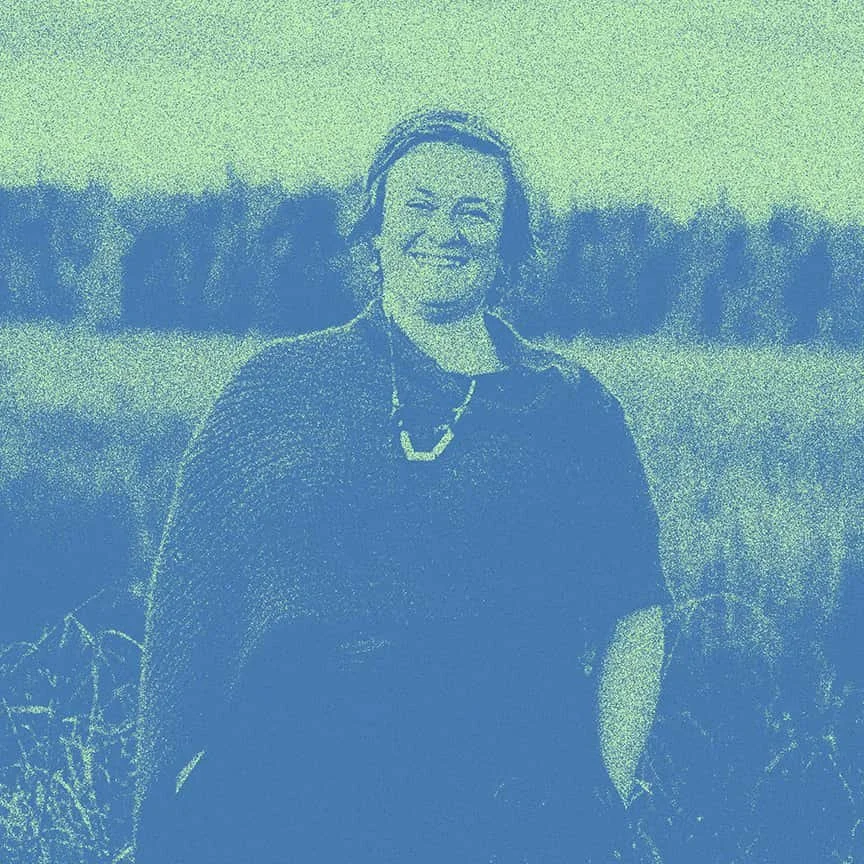
Photo by DeeDee Morris Photography, courtesy of Jessie Harrold / duotones by Hot Flash Magazine
Writer, coach, doula , and mother. Currently in perimenopause.
“And I think there's a powerful potential in midlife to let go of all the selves you are not, and also let go of the promise that you are going to come out the other side triumphant—as if you didn't already have a purpose just by existing. Let us not turn perimenopause into yet another way women can optimize for some kind of ideal.”
Hot Flash: When I try to talk to my mom about perimenopause, I get deer in the headlights. Oh, I don't remember. Or, oh, it wasn't that bad — even though I totally remember it was terrible for her. There's a whole generation of women who wiped it out from their hard drive's memory, or just don’t have the language for it. What was your experience of that silence?
Jessie Harrold: My mom had a medical menopause, and we didn't really talk about it. And similar with menstruation — we didn't even say the word period. It was very cloaked and secretive. I think there's this kind of perfect storm right now of our particular generation, and all of the influences we've experienced in our lives, with social media being a big one, where we have more desire to talk about this experience and there is this kind of unveiling of what's really going on.
I started perimenopause at 37. It was pretty clear in retrospect. At the time, it mostly felt like I wanted to escape my family and divorce my husband and everything that I had worked so hard to cultivate in my life was just garbage, especially one particular week of the month. I had some cycle awareness at that time, but I didn't have enough awareness of perimenopause to realize why my cycles had gotten so dramatic in their nature. I was experiencing really high highs and very low lows, and I didn't have any frame of reference for that, especially at 37. Within a year or two I met someone who has been a really good mentor along the way, and learned so much more, and realized oh yeah, there is a reason why I've been feeling that way. And that this is normal and this is going to take some time.
So many of us had to self-initiate through menstruation too. And birth; our culture is very clear that you shouldn't change fundamentally as a result of bringing a human into the world, that you should return to your old self. We're being stripped of the potential that exists in all of these rites of passage because no one's there to name it for us, even if we're feeling like, gosh, this is a big deal.
HF: We risk doing it alone. Or we just minimize it. We force ourselves, push ourselves, beat ourselves through it. We're also told we're supposed to be unchanged on the other side of it; the same expectation that your body should look the way it did before pregnancy, you should fit into the same jeans, you still have to be fuckably youthful. The best compliment you can get is, you look amazing for a mom. Do you find that's also expected as we walk through perimenopause—that we're supposed to somehow be unchanged, un-aged, to not have needs?
JH: Even within the context of my own life, there's this very classic midlife thing where you realize you have fewer opportunities now than you did twenty years ago. There was the moon flight recently—the astronauts going around the moon—and I got really obsessed with Christina Koch, the female astronaut. And there was a Jessie Harrold in my twenties who had broken a world record for the fastest swim across the Northumberland Strait from New Brunswick to PEI, who had a neuroscience degree and a Master's of public health, who had climbed mountains. I was on track for this really big life. And then I realized—somewhere along the way, probably around motherhood, there were ways in which I didn't actually want to participate in capitalism in the same way I had been. I didn't want to participate in hustle culture. I didn't want to identify with titles and accolades. I mean, that's something I'll probably still grapple with my whole life because I'm a Capricorn. But I made choices, actually, to live a smaller life.
And then I had this moment a couple of weeks ago when I saw that big life mirrored in Christina Koch, and the ghost of who I didn't become came to visit. A classic midlife moment. And I don't think I get to bypass those feelings. So yes, there's this external pressure to stay the same, but I also think there's this internal feeling of maybe a little grief. That's what was really happening there—some grief.
HF: Is the grief woven a little bit with motherhood for you? For me, it's that I chose this path and committed to it, and it's just not possible to have it all. There's the path not taken, comparing it to the path I have taken. And then also—my soon to be eighteen year old is moving out in September.
The story that he and I have shared all this way is now changing. We're both fumbling—I catch myself mothering him in a way he finds a bit much or maybe even not enough. He'll say things like, I've got it, I can handle it by myself. And then sometimes he comes back looking for reassurance, wanting to feel the safety net of being my child.
JH: I think there's something really interesting happening for the people I know and work with who are in their middle years going through perimenopause, and their children—of various ages—have gone through the pandemic and are living through ongoing collapse. Talk about perfect storms. Biologically, what our bodies are doing during perimenopause is actually causing us to give fewer fucks. Our estrogen levels are dropping, which causes us to lose that desire to tend to everyone around us. That nurturing instinct, that biological wiring, is shifting. Progesterone changes also cause us to want to get away—we have this flight response that heightens as well. So we are going through this very biological experience with children who are navigating a really unprecedented world, and our kids actually aren't okay. I know so many people whose kids are medicated for anxiety, and school refusal rates are through the roof.
Here we are losing that biological wiring to nurture, and our kids actually need more from us than they probably would have for our foremothers. So there's this real tension and conflict. The mothering I thought I was going to be doing at this age is very different from the mothering I am doing, which is far more intensive.
HF: And we need way more downtime than ever before, some of it consciously chosen, some of it non-negotiable for baseline function. You’ve said before that what matters most to you becomes refined in peri. As you know, I'm a practicing occultist and psychic medium via Ceremonie, so clarity is a professional necessity for me, and even I am floored by how loud the refining and clarity are right now. What has become more important for you through this process?
HF: Did you have to go through any inner negotiation around it being off brand?
JH: Not even a little bit. In proofreading, there have been a couple of moments where I was like, maybe I should tie this into my work somehow. But it's a memoir and it follows my life over the course of a year, so my work does come up a couple of times — just not in a here's-a-framework-you-can-use way. Not inherently of service. And yet, ironically, I think it may be more of-service than anything I've written.
HF: By not being of service, it is being of service. Tell me about the book.
JH: The name, at least currently, is Seachange: A Memoir of Mothering, Midlife, and My Year of Daily Ocean Swims. Last spring equinox, 2025, I was walking on the beach—I live right on the beach—and I was trying to think of a way to honour the equinox. Shit had gone down in the winter and I wanted to metabolize it and move into the season in a meaningful way. I came up with the idea of going in the ocean. It's not unusual for me to cold dip, so I thought I'd wash off the season that had passed and step into the new one. And then by the time I hit the end of the beach, it went from once to once a week. Then maybe a season. By the time I reached my front door, I was going to go swimming in the ocean every day for a year.
In the beginning I didn't fully believe I was going to do this, so I was pretty quiet about it. It took me probably three months to realize it was actually happening; this really quiet unfolding. I completed my year this past spring equinox, about six weeks ago.
JH: It's always been more clear and more simple than I realize or give myself credit for. I've become quite aware of my gifts and what I'm here for, and a little bit more unapologetic about that. I'm a writer, and I'm here for that. In terms of career, that feels a lot more clear. I probably would have tried to talk myself out of that ten years ago.
I'm also increasingly aware that the importance of tending to my body and my wellbeing is getting refined for me. Part of it is I can't just drag this meat sack around accomplishing all of my goals. The meat sack is talking back. I have to take responsibility for my wellbeing in a way I've probably been giving lip service to, but it needs to become a part-time job. Maybe even full-time.
HF: Was that what you did before — just override, override, override?
JH: Oh yeah. I'm a Capricorn. My moon is in Aquarius.
The other clarity I've had in midlife is that there are some things I'm always just going to grapple with. I got here with a few tasks that I am going to die with. Before, I was trying to solve for them, like there was going to be some utopic ideal whereby I would feel perfectly well cared for, or that I wouldn't have a tension between my work and everything else. And I actually realized I'm going to take that to the grave. So there's some peace that comes with that. I don't have to solve for that in the long run. I just have to solve for it today, and then tomorrow. I'm probably going to get it wrong a lot. I might have entire seasons where I'm ignoring my body in pursuit of a goal. And I think that's probably just going to be a thing I grapple with, and I'm okay with that.
HF: I'm definitely there right now. My identity is so wrapped around productivity, not necessarily capitalistic productivity, but my goals, my list, checking them off. The ‘doing something’ has always been me. And I'm realizing that the flavour of the chapter I'm currently in is the ‘being something’. But the being seems to take on a private quality. It's not for an external audience. It's entirely meant to be self-consumed, as in, existing for myself, and that is not natural for me.
JH: I've also been in that process of discernment between—is this my internalized capitalism, or is this my nature? People come to me for that really grounded, methodical approach that they don't have because they're Pisces or something. I see it as a strength. The big growing edge for me is the amount of downtime, rest, what you might call ‘productive rest’, like knitting or reading, that I need at this stage in my life. My nervous system can't do what it used to be able to do. It definitely feels like part of the quest for this phase.
I do have this sense that a lot of my goals have been met. I've done a lot of what I came here to do, career-wise. So there's this sense of, now what?
I just finished a manuscript for a book that I just wrote for shits and giggles. It is not on-brand. It is completely creative in a way I've never accessed before, and it didn't actually have an end game or a strategy. It was literally an intuitive hit I had one day and I carried it out to the very end. And that's really interesting to me—what will open up when my outer world achievements have been made, when I cool my heels and follow the intuitive nudges, the creative nudges. Rest. What's going to happen?
And now I'm thinking about selling this book. In our culture, memoir needs to follow this narrative arc — the hero's journey, building to a climax and then resolution, where you've learned something, you've come out the other side different, transformed. That's what makes a memoir that sells. My year did actually have a bit of a climax, because my daughter underwent a major spinal surgery right in the middle of this year I had set out for myself. Being in the ocean every day was an anchor during this really scary time. So there was a natural climax. But at the end of it — we're promised this hero's journey where there's some sense of completion or accomplishment. But life just kept life-ing. At the end of my year, my daughter still experiences occasional pain and disability. I still have the same flaws I had going in. Am I wiser? I don't know. Maybe I'm older.
I unpack this in the book—this sense that we're promised and keep striving for a hero's journey, and we really feel it's owed to us. The tension of midlife is: actually, I'm just a little mammal, as our mutual friend and colleague Carmen Spagnola would say, “I'm just a little mammal and my life is cyclical, and I'm going to keep going through seasons of difficulty and seasons of triumph, and I might grow as a person as a result. I might not.”
And I think there's a powerful potential in midlife to let go of all the selves you are not, and also let go of the promise that you are going to come out the other side triumphant—as if you didn't already have a purpose just by existing. Let us not turn perimenopause into yet another way women can optimize for some kind of ideal.
HF:
I don't want another boss babe version for midlife.
And the promise of transcendence is what capitalism has really exploited. Really extracted, imported, commodified. I can see this now — are all of the women our age going to get on the peri train and be like, if I just sign up for this one framework or this coaching class, I'm going to be finally the person that I love when I’m post-menopausal? Fuck that. Because you're never going to love yourself if you don't love yourself. Transcended or not. You either accept and embrace or you spend your life constantly chasing a fictitious version of yourself that will always be just out of reach.
This is literally the first generation in modern times that have openly talked about this. We don't even have language for it yet. And it's so easy to be seduced by the idea of optimization. It's not a planned scheme — it's just that when you start feeling better physically, the temptation to keep tweaking is right there. I'm on HRT, and you feel like yourself again, you can sleep better, you're not in pain all over your body. And then it's like, well, what else could I do? It's easy to start falling into that trap. It's not an on-off switch. It's a gradual path, and then all of a sudden you realize — holy shit, I just drank the optimization juice.
I want to close with this: who do you envision yourself to be on the other side of this?
JH:
I want to be someone who isn't fighting the circumstances of their own life.
Particularly in that week before my cycle, which has just become such an intense time, I often say the contents of what is happening are important and necessary to pay attention to. They're bringing information to me. The bigness of the way I experience them is maybe more than what's adaptive. I'm-gonna-burn-it-all-to-the-ground, right? But what am I burning to the ground? That's interesting. I'm still in the fires of that a little bit, collecting data. What feels so hard in that week? The not-enough rest. The not-enough emotional connection. The too-much emotional labour and mental load. The not-enough long walks in the woods talking to chickadees.
And then I can use that information to try to make some shifts that feel in service to my aliveness.
◆
The views expressed in this interview are those of the interviewee and do not necessarily reflect the views of Hot Flash Magazine.
Jessie Harrold is a coach and doula who has been supporting women through radical life transformations and other rites of passage for nearly twenty years. She works one-on-one with women and mothers in her practice as well as facilitating group programs, circles, rituals, and retreats. Jessie is the author of the award-winning book Mothershift: Reclaiming Motherhood as a Rite of Passage(Shambhala 2024), the editor of Mother Becoming: Reflections and Scholarship on Matrescence (Demeter Press 2026) and the author of Project Body Love. She is also the host of The Becoming Podcast. Jessie lives on the east coast of Canada where she mothers her two children, writes, and stewards the land.
Follow Jessie on Instagram or visit her at jessieharrold.com