Dionne Grayman: Risk-Excitement and the Third Adolescence
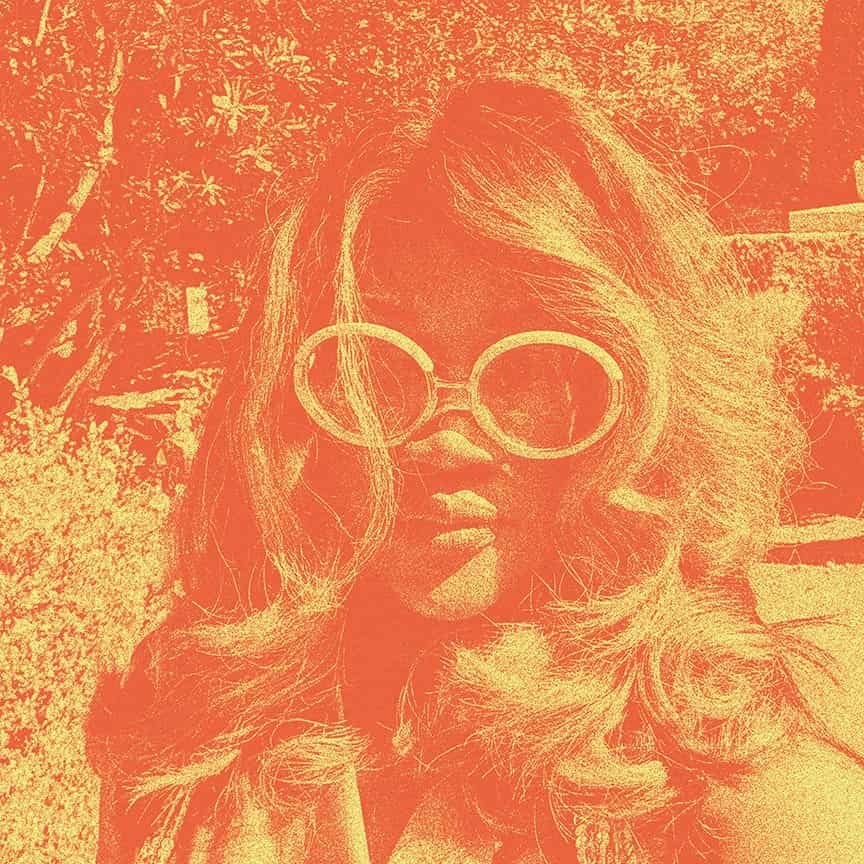
Photo courtesy of Dionne Grayman / duotone by Hot Flash Magazine
Systems strategist, educator, and cultural practitioner, forthcoming author. Post menopausal.
“Be the tsunami. Because even in the face of utter destruction and chaos, something new and better, and greater than before, always emerges.”
Hot Flash: Dionne, are you in peri or post?
Dionne Grayman: Post. Thank God.
HF: [Laughs] You have extensive experience and expertise, working with adolescents. And yet perimenopause is sometimes described as the second adolescence of sorts. During biological adolescence, it's a time of self-discovery, self-permission, differentiation. What has happened for you when you reflect back to your peri years? What kind of growth, or permission, or liberation did you experience?
DG: Do you know what it takes to be a mom and witness your child's suffering? My friend said to me the other day that his mom told his oldest sister that as a mother, you're only as happy as your saddest child. And when he said it, I was like, oh, that's ridiculous. And then I was like, wait. Oh.
I became a mom for the first time at 20, so still in that adolescent period myself, and had to jump a few learning curves quickly so that I could be the kind of mother I wanted to be—which was most of my mother, because my mother is a Mother Mary kind of mother. But also the parts of me that always held on to imagination and dream in the way that children do. That's always been a thread. And so I always wanted that as part of my mothering, because my ability to be in that time was always precarious. It wasn't a given, given the adult machinations in my life.
So in my mothering, I wanted my mother's sense of mommyhood, less of the martyr part and a lot more of the play. That's my wellness compass. Where I am with imagination and curiosity and play—that's how I know whether I'm fully well. And for perimenopause, I didn't have a lot of access to that. I was in a near-constant state of reinvention, of evolution, from 35 to 40.
It was always bringing me closer to the shores of me—but there was a lot of dying off of old pieces and emerging of new pieces. Because it was happening in real time and I had to deal with it in real time, I didn't have time to process it or even think about what was going on.
And so now, where I am, I'm back. I'm able to be in that imaginative curiosity state. So I feel like I might be having a third adolescence. My friend used the phrase yesterday: risk-excited. Isn't that powerful? Third adolescence—being post menopausal.
HF: Is the grief woven a little bit with motherhood? My seventeen-year-old is moving out in September, and I'm noticing all the emotions around it… how did he grow up in the blink of an eye, all the moments where maybe I feel like I didn't cherish him enough. And then there's also the fear of, who am I when I'm not a mom? And where am I going to make new friends, because friends have always been around the children. Sometimes I catch myself at 3am thinking, am I going to be the senior who's been granted my wish of having spare time, but then feel lonely?
DG: My youngest is 21 and graduating from college in two weeks. During her freshman year in 2022, every student from preschool through university was still carrying the collective grief of COVID, and my daughter was living with anxiety the way so many young people were. I knew that the take-her-unpack-her-spend-one-night approach was not going to work, so I planned to stay for the week because I knew my daughter. And honestly, I also needed that week to breathe into this new thing. My mother came. Our family tradition is everybody goes on move-in day—12, 15 of us. My sister's four sons, my three children, cousins, aunts, uncles.
Sonia, my daughter, is the only girl on both sides of her family and my youngest child—she has two older brothers and four male cousins—and the protection around her is something we all hold tightly. So I stayed for the week. And on my last day, a dragonfly was flying near the window as she was coming out of the dorm. The thing was the size of a Subaru. It terrified us both, so it was a very quick hug—she was trying to get back into the building and I was trying to get into the car. The dragonfly spared us the whole I-can't-leave moment. We laugh about it now.
HF: I want to go back to what you said—you're only as happy as your saddest child. Given your experience working in the school system, the bureaucracy, the need to ask youth to be contained instead of expressing curiosity—it's essentially training people to hold shapes instead of be their shape. How did you, as you were going through perimenopause, tell that truth to your children without becoming despairing? And there’s the layer of race in that, too.
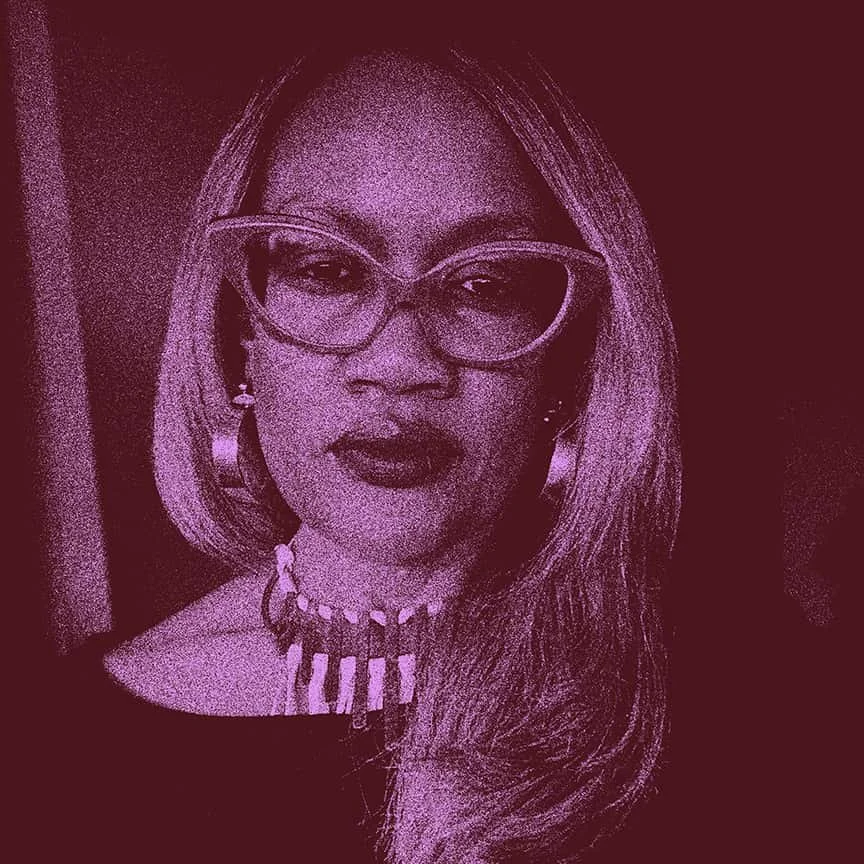
Photo courtesy of Dionne Grayman / duotones by Hot Flash Magazine
HF: You were training this probably before 10, but formal training when you started reading James Baldwin at 10. Advocacy and activism started early, because race requires it.
DG: Yeah. And it's the family business, honestly. My family's business is activism and advocacy.
HF: That's beautiful. …and exhausting.
DG: [Laughs].
DG: Because I'm African American.
Because I am Black, because I come from people who in captivity created, innovated, resisted, persisted, and thrived and flourished.
My dad made me read [James] Baldwin at 10. It was a requirement. I didn't understand what it meant, and he didn't sit down and talk through concepts with me. He just made me read Baldwin beginning at 10. I had to read Roots [Alex Haley] at 11. He gave me Manchild in the Promised Land [Claude Brown]. I read everything that was on the shelves because he said read them. Even the things he didn't say read, I already knew I was expected to read because they were on the shelves.
I was valedictorian in sixth grade, the smartest student in my class, sent to a gifted program outside my neighbourhood with teachers who didn't look like me. I was one of 25 Black and Brown students in a field of 100 in seventh grade, and by ninth grade there were only 10 of us left. The majority of us were girls.
Even in high school, recognizing where adults didn't see me fully—they saw me through their limitations. Those were classes I did okay in, because why give them my effort and energy? And then the classes where I knew I was fully seen—my genius was allowed to speak for itself and I didn't need to define or defend any of that. So as a teacher, knowing how I - as a smart, nerdy, wonky, whimsical, introverted Black girl knew the kind of classroom I thrived in—I started to recreate that in every school I was in, whether I was a teacher in the building or not.
Yes, there was the grief of it all, but then there's the joy. Bringing in music, bringing in literature, bringing in reflections of ourselves.
That was like, oh no, this is how we see ourselves. We don't even have to consider how other people see us. Not only bringing that in for my students, but being that, even on the days when I didn't believe it myself. Knowing that my students needed to see it allowed me to put on whatever face I needed to for them, even if behind I was cussing, crying, calling for Jesus. Because I knew what my students needed. It didn't matter the setting, the school building, the community—if I'm in this space, you're going to know what it feels like to be right, and to be celebrated for who you are.
HF: Did you experience a spike in that when you started entering perimenopause? What was the fuel — was it joy, was it rage, were your kids the fuel? Who or what?
DG: Motherhood. Because motherhood holds all of those things. Each of my three pregnancies, each of my three children, happened in different contexts and at different stages of my life. Young 20s, early 30s, mid-30s. My body was doing different things and my context was different in all three ways. Motherhood is the vessel for the vastness of the human emotional complex system. As a mother, you can be in any one or all of those contexts at any given time, at the same time.
I was definitely in the activist and activism stage in my perimenopausal years. I joined an organization—which I'd never done, as an introvert, because who does that? I became president. It was called Mocha Moms and they're still in existence. In our Brooklyn chapter I gave us social justice not as a cause but as a responsibility. And I gave us the responsibility of taking care of ourselves, finding and fuelling and refining our dreams. I made that a requirement. You do the inner work so you can do the outer work.
“And I gave us the responsibility of taking care of ourselves, finding and fuelling and refining our dreams. I made that a requirement. You do the inner work so you can do the outer work.”
—Dionne Grayman
DG: And then the part of my perimenopause aka second adolescence that makes you think about what everybody else is going to think about hit me so loud and so hard that I stopped. I went straight into get along, do what everybody else is doing, don't stand out. For about 10 years. My 40s was a period of just get along, don't make waves, fit in, see what everybody else is wearing.
HF: And then what prompted you to shift out of that?
DG: My daughter. It worked well for me, yes. But there was a huge cost I paid in terms of not aligning the inner work to the outer work. I forgot what my voice sounded like. And on some days, I forgot I even had one.
I was on a day boat trip around NYC with my parenting partner and my daughter, who was 4 at the time. When we got off the ship, we took the requisite keepsake photo. When we received the prints, I didn't recognize myself. I didn't know who I was. I don't think I ever gave sound to that pain. I recognize it now as self-betrayal.
And it took me a long time. I kept pushing that down until I was looking at my daughter going, I don't want to pass this on. I have to figure something out. And even subconsciously, I was like, I can't keep being hard on myself, that's all I've ever done. So let me start being soft on myself. I used the way I cared for my daughter to model what it would feel like for myself.
HF: When you're approaching responsibility not from a place of burden but from a place of love, it shapes you and softens you and makes you go inside out.
DG: My parents taught me that love is a responsibility. And the privilege as an educator, or just as a person in this world, is the deep regard for that responsibility and honour of loving someone else's child like you do your own.
I don't play with that. And when people talk about accountability — that is my standard. I expect adults to meet me there, and I will do what I can to get you there. But if you refuse, if you appear unwilling or unable, I will punish you. I do. I will find ways to make you feel it.
HF: [Laughs]. Tell me how you do this.
DG: I'm learning to do it with a lot more tenderness. I'm a high school English teacher by trade, because words are very important to me. Words don't just convey meaning—words hold weight and they matter. So if an adult—principal, guidance counselor, dean, social worker, whoever—says to me that they care about a child, I'm going to start with your words. I want your definition. Because then I want to be able to say, in this interaction, I'm curious as to where you see care happening in the way you spoke to that student. I'm curious to hear how you think care was conveyed when the student is sitting in the back and you haven't acknowledged their existence in the 45-minute period I've been in this class.
I start with the definitions because words carry weight. As a principal, the first thing I do is look at your vision statement, your mission statement — because here it says you do this, and yet when I come into your school building, the school safety officer is making me feel as if I'm intruding on her time. That tells me already what the energy is in this school. I'm curious to see how you see your vision from the front door on.
I had the opportunity to soften. The way I'm saying it now feels really fluid, but I can — respectfully, I'm from Brooklyn—I can adjust tone. And it lands like a soft tap. We say mush: you get mushed. Front or back of the head. Back of the head hurts, front of the head is disrespectful. So I can adjust tone. Over time I've learned I don't always have to lead with the mush. I can start with a gentle tap.
I was given the gift of figuring out how to adjust the volume with a principal who viewed herself as a fierce protector of her school-and she is-but her approach was causing a lot of harm in the process. I didn't want to damage our relationship because I really value her as a person.
HF: I really see how much consideration—first analysis, then scenario planning, then the actual delivery of whatever level of volume you have in mind. But it's so much on the body and the brain ahead of time. That's whiteness—it doesn't develop these muscles of scanning and interpreting and analyzing and then plotting out scenarios, deciding how loud the volume needs to be, what words to use, what words to avoid, how to open the conversation. All of this that an othered body has to do, and gets actually really skilled at. Did you ever experience the — oh fucking hell, I don't want to do this all the time—during those estrogen-depleted years?
DG: Yes. And thank you for the reminder of the body. After I had my last two children, I gained about 50 pounds. I started exercising, doing cardio five to six days a week, started running. That somatic practice really helped to regulate in ways I didn't have language for then, but credit that now. And also hip-hop, because hip-hop is medicine. I listen to hip-hop every day and twice on Saturdays.
This past summer, I was in deep depression that was threatening me with a paralysis of sorts and seducing me with false images of what giving up could mean. For three or four weeks, my mantra, my prayer, was to not succumb. I would squeeze into a small space on my terrace, sit in the sun, and repeat that mantra. No. Just no.
Water is the most healing thing for me. Music keeps me together until I can get to the water. Water makes me whole. And I made it. I made it to the water.
And so making it to the water meant I am reconnecting—not even reconnecting, recalibrating—my risk-excitement. And I'm leaping now, not thinking about what the landing is. When you're a kid you don't think about sticking the landing. You just jump. That's the part of the third adolescence—the impulsiveness.
The times my friends and I did things we had no business doing were always the best times. Especially when the risk was underlined in red and flashed "WARNING! WARNING!" Those times when everybody knew, this probably isn't a good idea, but we're going to do it anyway. And those always end up being the best ones. That energy is what's resurrected. That's what I'm reclaiming. Let's have fun. Why not laugh out loud? Why not wear two different coloured socks?
Photo courtesy of Dionne Grayman / Duotone by Hot Flash Magazine
HF: That permission. I notice your memoir is called I Call My Own Name. Is it about sovereignty? Having full access to calling your own name means you can call your own existence. As a woman or a person with female physiology, society primes us to be desirable, to be chosen—look a certain way, sound a certain way, be nice and polite and chaste. But when you call your own name, you say, I am chosen. I chose myself.
DG: And here's another layer—
when you're Black, you are never viewed as the nice girl. From young, you are viewed as the forbidden, a forbidden desire, but also as a receptacle for lust, whether you want it or not. Against your will.
So there's the priming and then there's the conditioning. And nobody wants you when you're a Black woman—they want the aesthetic, the full lips, the curve, the sass. They don't want you, because you're too much, you're too loud, you're not submissive enough. That gets internalized.
DG: I want to love on my friend Kamilah who right now is in the hospital recovering from emergency surgery. We were in a car coming back from a Bell Hooks symposium, because this conversation could only come from a bell hooks symposium, and we were talking about pleasure and self-pleasuring. And Kamilah said, sometimes it is so good I call my own name. I was like, the first book I write is going to have that title.
It's sovereignty, but it's also recognition of your own deliciousness. If nobody else desires you—which is absolutely ridiculous to even believe, think, or comprehend—you can hold yourself by calling your own name. And I got confirmation of this. I was in Montgomery in January, in a learning session with a woman who talked about being institutionalized three times as a young mother. The third time — a Black woman in Montgomery, Alabama in the 60s—she said she picked up the Bible and began putting her name in the names of the disciples, the prophets, the kings, the warriors. The chills I got. She's now in her late 70s, early 80s, with the most popular and successful catering business in Montgomery, Alabama. There's power in the word.
When I started calling my own name, I was able to bring myself down from the place of martyrdom and unnecessary suffering. I got myself up out of the tomb and walked around with new raiments on, remembering my own glow, for me.
If we're in the wilderness 13 to 14 years, we are needed. We are essential. This is our time, this is our work. We know how to do this. And I think for so many of us, even as whispers, those of us who know what this time is—I think we baffle people because we're so excited. Everybody is like, how can you be calm? And maybe I'm excited and calm. Maybe people are still scared and nervous, and that's fine. But there are those of us who are recognizing exactly what this time is. Maybe the word is prepared, or aware. We're finding each other.
HF: Are you talking about perimenopause, or are you talking about the current state of U.S. and global politics?
DG: Both. All of it. The conversations our mothers had—my mother was progressive and liberal, we had straight-up conversations. But my mother had a hysterectomy and just went from this loving person to, oh, I'm gonna have to have her committed. Never talked about it. Menopause to me meant hot flashes. That's all I grew up knowing.
So I'm glad we're in a time where we get to have these conversations.
Menopause doesn't mean I'm no longer desirable, no longer curious, no longer imaginative, no longer risk-excited.
HF: My clarity—the fable I resonate with most out of all the fables is The Emperor's New Clothes. And being in perimenopause has heightened that ability even more. When I was younger I knew what was going on but I didn't necessarily say it. Now I'm saying it. I'm still in the period where I need to learn how to adjust the volume. I'm still learning. But damn, I'm like, why the hell did I stay quiet for as long as I have?
Part of it is that my children prepared me. I had to advocate for them time and time again through school systems. And I live in a neighbourhood that was not built for people like me. White suburbia, polite social compliance, and a spot on the right committee—where the unspoken rule is that you make yourself small enough to fit in, and call that belonging. In a way, all those conditions prepared me to ask, well, who am I living my life for?
If you could sit across from your earlier perimenopausal self, that period in your 40s where you were telling yourself to not going to make waves, and you wound up losing your voice as a consequence of it, what would you say to her now?
DG: Be the tsunami. Because even in the face of utter destruction and chaos, something new and better, and greater than before, always emerges. Always emerges. When we do this again, we'll know how to do it better, we'll know how to do it so that we are so attuned to making sure that belonging is the priority and fitting in is not in our vocabulary.
No one is better at being audacious than a woman in perimenopause and menopause, because the hot flashes are a different level of diabolical.
I have hot flashes and that should suffice as its own reason for anything. It should be sufficient currency for everything and everyone. Acknowledgement of the amount of pressure and energy I am exerting to keep you safe. The heat I'm experiencing could easily be transferred onto you. It could heat my house. By the good graces of all that is divine, you are not the recipient of this heat — and for that you should be thankful.
HF: [Laughs]
DG: I come from a line of outspoken, don't-give-a-damn, I'm-gonna-do-it-my-way women on both sides. My grandmother wore bright red lipstick. She took pleasure in things even when there was hardship. Those are skills. My grandmother was a cigarette-smoking, whiskey-drinking, card-playing woman who could hold her own against my grandfather, who was six feet tall. She prioritized her pleasure. I understand that now in my body. It goes back to I call my own name.
We are the blueprint. That's the thing about Gen X. We actually are the blueprint.
HF: I have no idea where this is going to take us. We don't know where this is going, and that's the dopest part.
DG: We know we're going to have a good time. Let's have a good time.
◆
The views expressed in this interview are those of the interviewee and do not necessarily reflect the views of Hot Flash Magazine.
Dionne Grayman is a systems strategist, educator, and cultural practitioner whose work centers healing, leadership, and collective care. Grounded in the belief that caring for Black women begins with caring for herself, she brings a values- driven approach to building spaces where vulnerability, reflection, and courageous leadership can thrive.
A granddaughter of Island peoples and Southern folk, Dionne draws on storytelling as both a love language and a leadership tool to create environments where people feel seen, heard, and invited to grow. Her work is rooted in nuance, context, and deep listening, shaping structures that are both strong and flexible, inclusive and celebratory. Even as she holds the realities of grief, Dionne leads with a commitment to joy, delight, wonder, and ease, believing that when people are supported in their full humanity, they are better able to build systems that reflect wholeness.
Dionne is coming out with a memoir, I Call My Own Name: A Homegirl's Lyrical Memoir of Healing, Hip-Hop, and Holy Reclamation, out this November 2026.
Follow Dionne on IG @DionneGrayman or @thevintagehussy, her LinkedIn, or Vintage Hussy on Substack. You can also find Dionne on DionneGrayman.com