Carmen Spagnola: I've Never Met Me at a Better Time
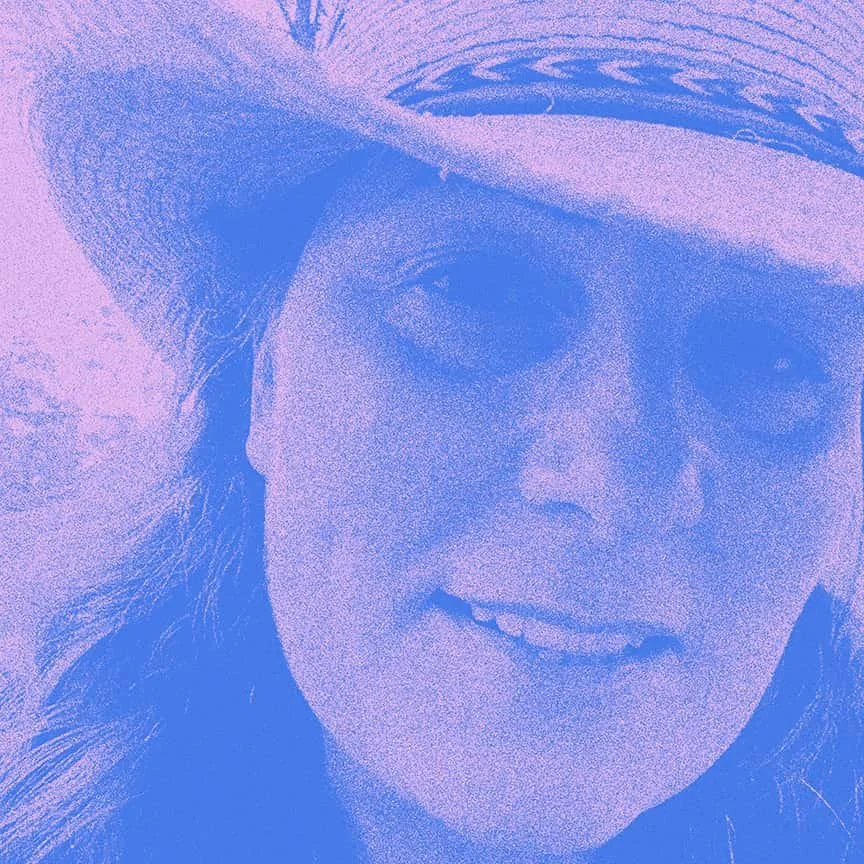
Photo courtesy Carmen Spagnola / Duotone by Hot Flash Magazine
Somatic trauma practitioner, author, founder of The Numinous Network. Currently in perimenopause.
“I’ve been craving my 50’s since I was in my 30’s and have always found women in their later years quite alluring, so generally I have loved perimenopause because I can feel my power growing!”
HOT FLASH: For our readers, Carmen, are you peri or post?
Carmen Spagnola: I’m in late perimenopause. I’ve probably been in peri for the past 7-8 years, but for the past two years I’ve had a few 150–180 day cycles so I know I’m getting close!
HF: You're someone who is high functioning, well resourced, and no stranger to doing hard things. So I want to ask you honestly- what has been the hardest part of perimenopause for you?
CS: Thank you, and thanks for asking. I’ve been craving my 50’s since I was in my 30’s and have always found women in their later years quite alluring, so generally I have loved perimenopause because I can feel my power growing! But the hardest part has definitely been all the years I spent in discomfort and pain because I’d never heard of genitourinary syndrome of menopause which is a collection of symptoms caused by decreasing estrogen. For years I had an itchy vag, burning and stinging on the skin when I peed, and dry, delicate skin that could tear just from wiping with toilet paper. My poor lady bits hurt 24/7 and made going to the bathroom and sex really difficult and painful. Apparently none of the half dozen doctors and healthcare clinicians I consulted with thought to put two-and-two together with my symptoms and my age because of the misconception that if you’re still bleeding regularly, you’re not in perimenopause. Since I’ve learned that some form of significant vaginal discomfort will happen to upwards of 80% of people who menstruate AND vaginal changes are quite visible (with less pink colouration and more tissue-like skin texture) I am SO PISSED that SO many people saw my pussy and NOBODY asked if I was using hyaluronic acid lotion to soothe my skin! I was prescribed every kind of antifungal, antibiotic, and yeast infection cream but that was not what I had. I was made to feel unhygienic and left to suffer–for years. I’m now on a crusade to tell everyone I know about GSM to save them the irritation and pain.
HF: Among many things, you work with nervous system regulation and what you call the collapse place, where people go when something within or around them is giving way, including the perimenopause anxiety that can ambush even the most self-aware people. You know exactly what's happening in your body and your nervous system during this transition. Has knowing made it easier, or has it just meant you've had a more articulate relationship with the difficulty?
CS: I would say mostly the latter. Like most people, I can identify the symptoms of perimenopause in others much more readily than in myself. That said, I think the combination of sensitivity to my body’s signals coupled with a very high regard for ageing women has helped me to embrace this life transition with gusto. Although I am a highly productive person, I’m also deeply devoted to anti-capitalism so when it comes time to rest, I love to rest! I have at least ten pyjama sets, multiple eye pillows, heavy duty hot water bottles from Germany, creams and lotions and potions on my night table, a yummy magnesium drink to wash down my progesterone pills, sleep tracks cued up on my phone in case I wake up and need help falling back asleep…I’m gonna rest like it’s my role in the resistance and my people depend on me to succeed, because they do.
HF: We've been in each other's orbit for some years now, and what I've noticed is a real shift and expansion in your work, especially these last two. Not exactly what perimenopause has a reputation for. How much of that do you think perimenopause can take credit for, and do you experience it as an incubator, an accelerator, a birther of something new?
CS: Oh, 100% I’ve been waiting my whole life for this level of freedom and agency. Definitely I feel renewed. Not that I don’t also feel exhausted sometimes, but thank goodness for Menopausal Hormone Therapy! What a game-changer. But yes, certainly I have enjoyed the shift from that somewhat insular, self-reflective Persephone phase to a more Fuck You What Have You Done to My World, sovereign energy of Demeter.
I love my rage and that I have the power to terrify and terrorize men.
I adore the freedom that comes from being so much further removed from the male gaze and internalized patriarchy. The me that has this many years under her belt of de-centering men and beauty ideals and youth is more me than I’ve ever felt. I’ve never met me at a better time in my life.
Perimenopause has birthed a kind of me that is so much more capable of following through with a promise of, I can handle it because I know my limits now. I know me now. My yes’s are so much more potent now that I have a deep and abiding NO. What I give myself to now has a much longer time horizon and is much more inclusive and collaborative because I can sense the limits much more accurately now; I know I need help and what kind of help I need, and I’m quicker to pump the brakes when I sense something’s not quite right.
I only have so much energy and time, and there’s a lot less than there used to be. There is a biological sense of rightness and wrongness that is highly recognizable in me which has always been there, but I am responsive to those feelings now in a way I was reluctant to be before. So yes, this is a re-birth, for sure. Perimenopause for me has meant hitting hard, hard limits, and I’m thankful for them. I feel like a living example of that notion that artists are more creative within constraints.
HF: What story about yourself did perimenopause make harder to keep telling? How has that story changed?
CS: I think for most of my life there was a quiet storyline in the back of my mind that is very rooted in capitalist patriarchy that I was just a temporarily embarrassed millionaire, that any day now my work was going to be discovered by a mass market and I would hit some jackpot of ‘right time-right place’ that would finally secure my finances. I’m not saying that good luck and a career of hard work won’t result in a more financially secure life for myself and my family, but perimenopause really woke me up to how much energy those kinds of fantasies can burn. There’s this What if I do more? How about I do this? And I could do that kind of energy that endlessly loops. I simply don’t have energy for fantasy anymore. I love my work and I love who I am and there are people who want to spend time in my spaces. That’s my true prosperity. When I release the need for the big payday, I have more time for what nourishes me in return. When I just do good work and let other people talk about it, (instead of me talking about it), I have more time for my horses, for my roses, for my giant pumpkin growing hobby, for cooking foods we’ve grown, for helping my husband on the farm, for supporting my kid. This is my real life and if I don’t get super present I’m going to miss it. The good stuff is happening right now and I don’t care if it gets any better. I just care that I get to experience it now. Perimenopause has put me in daily contact with that subtle little memento mori… nothing lasts forever. I’m not saying I don’t or can’t want more, but I am saying that if I can be satisfied with what I’ve got, what difference will more make?
HF: Has perimenopause changed what you need from the people closest to you, and if so, what are those things?
CS: Yes, I need the people closest to me to be women or queer or non-binary. Anything else is tedious. There are very rare exceptions.
HF: Your forthcoming third book, How to Connect: Build Strong Bonds and Deep Connections Through Contact Nutrition (No Matter Your Attachment Style, Trauma History or Neurotype),out November 2026 with 9th House Press, is being birthed at a moment when conversations about attachment, neurodivergence, and relational repair have never been more urgently needed, and when a lot of people in our readership are finding that perimenopause is doing something to their tolerance for dynamics that do not, or no longer work. What does it mean to be well-fed, relationally speaking, especially through midlife?
CS: Thank you for asking. Perimenopause can be a spectral presence in relationships, an energy shift that everyone can feel. Untended perimenopausal symptoms can cause a lot of relationship problems, for us and for others, if we're unaware and not tracking ourselves, if we're not prioritizing our needs, if we're not getting help and support from qualified healthcare providers.
Being relationally well-fed at this time of life means no longer trying to figure out other people's motivations and behaviours, and focusing instead on how we are being impacted and what we're going to do about it. We don't have enough bandwidth to flip flop or ruminate anymore. We need to decide whether the Contact Nutrition we're being offered is enough – by "Contact Nutrition", I mean the attunement, the meeting-and-matching – whether it is really enough for us to thrive.
We need to become very clear and precise about whether our relationships are mutual and reciprocal enough.
If they aren't, what's our plan to gradually re-allocate our energetic resources away from one-sided or subsuming relationships and invest our limited, precious time, energy, and life force into newer or fewer relationships?
It's the time to press pause, switch energetic tracks, and see what comes back to us, see how we respond physically, emotionally, mentally and spiritually, when we have more abundant attunement and reciprocity in our life. What becomes possible for us when we stop overfunctioning and let ourselves "under" function for a while? Who or what stays? Who or what fades away, dissolves or explodes? Whatever happens, this is good data.
HF: If you could sit across from yourself in early perimenopause, what do you wish you could have given her?
C: Prescriptions for estradiol and progesterone, a bottle of hyaluronic acid lotion for her vag, her own self-contained office/outbuilding, and $100K so she could take a year or two off.
◆
The views expressed in this interview are those of the interviewee and do not necessarily reflect the views of Hot Flash Magazine.
Carmen Spagnola is a somatic trauma practitioner with an online recovery space called The Numinous Network, now in its fifth year. She's also a two time author with a new book coming Fall 2026 about Contact Nutrition, a way to create strong relationships no matter your attachment style, trauma history or neurotype. She lives with her intergenerational family on a subsistence farm on Syilx Okanagan lands in the southern interior of British Columbia.Carmen’s work can be found on @carmenspagnolaand carmenspagnola.com